
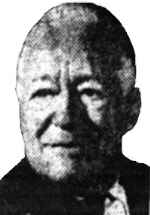
Powers Gouraud
1950

Powers Gouraud, "The Old Night Owl," began some of his earlier nightly commentaries on WCAU radio, which was sponsored by Yellow Cab, with "Yel-low, night owls and night owlettes, yel-low!" The Yellow Cab sponsorship started in 1936 and continued for more than a decade.
Tom LaBrum was a pal of Powers and was in the thick of all those whom needed media attention. There were nine daily papers earlier in the 20th century: The Inquirer, Record, Bulletin, Telegraph, Times, Public Ledger, Evening Public Ledger, Press and North American. Tom, during his heyday, was one of the nation's foremost theatrical press agents. His assignments kept him hopping, along with his colleague, Powers Gouraud. Powers was making use of that new journalistic medium, radio. They both found time to visit the nightspots that sprang up everywhere. These were the speakeasies spawned by Prohibition. The Walton Roof was a favorite spot under the direction of Jack Lynch and his friend Evan Burroughs Fontaine, and guests there could be entertained by Sophie Tucker, Georgie Jessel, Frank Sinatra and Dean Martin.
Powers St. George Gouraud was born in 1881 in England, although both his parents were American. Powers' father was George Edward Gouraud (often called "The Colonel"), an United States Civil War veteran. George was Thomas Edison's British sales representative and the family lived in Little Menlo, Beulahhill, Upper Norwood. Colonel Gouraud's voice recorded on Edison Wax Cylinders (there are at least ten different ones) is one of the oldest known sound recordings in existence anywhere in the world. These recordings were made inside the Gouraud home. On July 14, 1888, an article in the Illustrated London News reported that Edison had sent to Col. Gouraud a message via cylinder. The article said that it was "a private letter from Mr. Edison to Colonel Gouraud, consisting of about two hundred words, treating of business and family affairs. Mr. Edison’s voice was recognized by every hearer in Colonel Gouraud’s house, including a child seven years old." That child, by the way, was Powers Gouraud.
From October 7, 1901 to December 2, 1901, Powers was a featured player in a music theatrical production. It was called The New Yorkers and was performed at the Herald Square Theater on Broadway.
On Saturday, November 16, 1912, a New York newspaper announced:
Announcement has been made of the approaching marriage of Powers Gouraud, brother of the late Jackson Gouraud, to Miss Irma Hunt Schlesinger, daughter of Mr. and Mrs. Sol Hunt Schlesinger of this city, which is to be celebrated on Wednesday, November 20th at the Hotel Savoy.
Mr. Gouraud in 1903 married Gladys Ashe, daughter of Amy Crocker, and her first husband, P. Porter Ashe, and was divorced in 1907 in Sioux Falls, SD. His marriage to his brother's stepdaughter brought about a rather involved relationship, his sister-in-law becoming his mother-in-law, while his brother became his step-father-in-law, and furthermore his bride became her step-father's sister-in-law, and by marriage, she also became sister-in-law to her own mother.
He is 31 years old and is living at the Hotel Rector. He met Miss Schlesinger a year ago at a reception given at the Savoy.
Mrs. Jackson Gouraud, who recently returned from Europe, will attend the wedding of the divorced husband of her daughter. The wedding will be a quiet affair, and Mr. Schlesinger, who is a manufacturer of clothing, will give his daughter in marriage. Miss Ethel Davis is to be the maid of honor, and Emerson Foote will act as best man. Justice P. Henry Dugro of the Supreme Court will officiate. Later, Mr. Gouraud and his bride will go aboard for six months.
On February 12, 1922, Powers wrote an article for the Philadelphia Public Ledger. It was called "The Amazing Aimee Gouraud." Aimee was one of his sisters-in law. However, Aimee was married at least twice before. It has been said that two men Porter Ashe and Henry Gillig played cards for her hand in marriage. Ashe won. They were married and divorced a year later. Then, she married Gillig. That union lasted a little longer.
According to Broadcast Pioneers member Sam Bushman, Leon Levy, co-owner of WCAU Radio found Powers working at the John Wanamaker Department Store. No, he wasn't a broadcaster on WOO Radio (the Wanamakers broadcast outlet). He was the head of the floor walkers for the store. Sort of a Captain Peacock for the Delaware Valley.
One of seven children and named after his uncle, the Rev. Horatio Nelson Powers, D.D., Powers Gouraud had a sandpaper voice, a British accent and assorted gasps, grunts and chuckles.
Stan Lee Broza, the first president of the Broadcast Pioneers of Philadelphia actually was the one whom hired Powers back in the summer of 1929. Powers liked everything scripted, usually in longhand. Broadcast Pioneers member Harry Harris (who later gained fame at the Evening Bulletin) was doing some freebie work at WCAU while he was still in college at Temple University. In the mid and late thirties, Harry started writing for Gouraud, a knowledgeable man but one whom liked everything prepared and Harry wrote the scripts. By the way, it was rumored that Powers has so many books that when not in use, his bathtub was used to store some of them. He hosted a late night program, "The Ol' Nightowl," which was a celebrity interview program.
In April of 1937, WCAU Radio started a new broadcast called, "Air Previews," which was heard Wednesdays and Fridays at 7:30 pm. The program was 15 minutes long and hosted by Powers Gouraud who reviewed new motion pictures. By the next year, it was on just on Mondays. The show contained an actual clip from a newly released film and then a review by Gouraud. Later in 1938, the broadcast was cancelled.
During the Second World War, Gouraud, a popular night club and benefit emcee, appeared on stage at the Bucks County Playhouse. He was in their production of "Lightnin'." During one broadcast, Powers Gouraud recalled, "Mae West lost one of her 'falsies,' an eyelash. Powers also was MC for a Frank Sinatra broadcast, "95 Minutes of Sinatra" carried over CBS Radio.
Powers was also an avid sports fan and a patron of the arts. His broadcasts were mostly live and heard over WCAU Radio. His interests were many. In the twenties, he wrote a song called "JE T'AIME" MEANS I LOVE YOU." It was made famous by Ben Bernie and his Orchestra. It was his only successful tune. However, he did write the words to the song "Another Language." The music was done by Charles John Borrelli.
Gouraud's air presence spanned three decades in Philadelphia broadcasting and he was highly thought of and well respected in the broadcast community. In May of 1951, he had a serious heart attack. This took him off the radio airwaves until the end of October of the same year. While he was recovering, he decided to grow a pencil-thin moustache. About that, he had remarked, "Too bad that the show isn't on television, so that people can note the remarkable effect." However, about TV he then added a definite no and then stated, "I'm too old a dog for some new tricks."
At the time of his return to the WCAU mike, he elected to cut his daily show to just Tuesdays and Thursdays. When he returned (on Tuesday October 30, 1951), his show was about "Black Chiffon," which had opened the night before at the Locust Theater. Just after his illness, veteran WCAU announcer, then a movie star, Paul Douglas sat in front of the WCAU equipment and spoke with Powers via telephone from the hospital. It may have been the first remote from a hospital in the Philadelphia area.
Powers also, at least for awhile, had a morning broadcast. On Tuesday, September 16, 1941, Gouraud had a 5 minute program at 7:25 am called "Brevities." In late November of 1950, Powers was on from 10 minutes daily from 11:15 to 11:25 pm, Sunday through Friday.
For years, Gouraud authored the theatrical column for the evening Public Ledger newspaper. In the Spring of 1934, Powers Gouraud wrote:
Radio dramatic criticism has its humorous side, also on occasions, a tragic angle. It has become quite the vogue in Philadelphia lately for members of a dramatic company, after an opening night, to give a radio party and listen to my ether reviews. Sometimes, of course, it leads to embarrassing situations. One night for example, it was my painful duty to give a particular play a very severe verbal chastisement. Later in the evening I met one of the cast and asked him how my comments had been received by his co-workers. He answered that the thespian listeners stood the roast very well, with the exception of the leading lady, who fainted.
Another time I hammered a certain play more than the players. The husband of the woman who perpetrated this particular atrocity gave a large after-theatre party to his friends, including the newspaper critics, the producer and the director. He called on me the next day, very angry, and said I had made him look ridiculous in front of his guests. He charged that I had ridiculed his wife, and bet me a new hat that I was wrong, that his wife's brainchild would thrive on Broadway and run in New York for six months. I won the Stetson by a wide margin. Milady's masterpiece expired after three performances.
However, to err is human, and I must acknowledge that I made one pretty bad guess last season. I hailed a drama as a hit, predicted a long run and raved plenty. This prognostication was very much all wrong, and the play went straight from Philadelphia to the storehouse.
Frequently, radio reviewing of first nights is a happy occasion. As when one rushes to the studio after an opening that looks like sure-fire, "a natural," as we say in the parlance of show business. It didn't take much imagination to foresee the box office possibilities of "As Thousands Cheer," "Pursuit of Happiness," "No More Ladies" or "Dodsworth." All of them opened this season in Philadelphia. On such occasions, lover of the theater that I am, it gives me a great kick to be able to tell my listeners the good news, and hail another hit. For the so-so, or in-betweeners, lukewarm praise goes over the air, but I do always try and make allowances for opening performances.
I try to visualize potential successes, and I do my best to give the producers an even break, without misleading the public. There is no doubt that playgoers like radio theatrical reviews, and performers themselves, who in the old days used to sit up for the morning papers, can now go to bed with a rough idea as to whether their latest show is going to "click" or "flop."
Powers was said to have a laugh which was really a chuckle. In fact, a few nicknamed him "Chuckles." It was said that his laugh was very close to his dear friend, George M. Cohan. You can listen to Gouraud interviewing Cohan on July 3, 1936 on our website. It also has a photo of Powers and George Cohan. It has been written that there was no one closer to George M. Cohan than the ol' Night Owl, himself.
In January of 1942, his show was on at 11:30 pm to 11:40 pm and sponsored by the Yellow Cab Company who had been sponsoring the Gouraud broadcasts for a half dozen of years. In a review in Billboard Magazine, reviewer Maurie Orodenker said:
Powers Gouraud, as the town's premiere radio raconteur, has long earned the soubriquet of "The Old Night Owl." ...A dramatic critic, connoisseur on table delicacies, songwriter, night club emcee, newspaper columnist, traveler, after dinner speaker, sports enthusiast and many other things, Gouraud brings a world of worldly background to his nightly banter about thing concerning Philadelphia. Rambles about the doings and things to come on the local scene, with emphasis on after dark.
While his puffs and patter may not be newsy, his delivery makes it all lively and diverting. And in an intimate and chummy tone that smacks of the dinner table or the brass rail, he has no trouble holding the dialers for his nightly ten minutes. ...Usual round of home town gossip tied up the stanza into a neat listening package. Sponsor plugs, institutional, tastefully interspersed.
In the spring of 1943, WCAU Radio originated a live 25-minute variety broadcast on CBS Radio hosted by Powers Gouraud. It was called, "95 Minutes from Broadway," because Philly was 95 minutes by train from New York City. It was on Monday evening/Tuesday morning from 12:05 am to 12:30 am and featured nationally known celebrities who just happened to be in town. Johnny Warrington and his band was the orchestra for the broadcast. Maurie Orodenker once referred to Powers Gouraud as, "home town talent raconteur, who is tops in the emcee spot."
On many of his WCAU broadcasts, the announcer that introduced him was Hugh Walton, an old WCAU radio hand. Walton, as many will remember, did the announcing on "The Children's Hour," hosted by our first President, Stan Lee Broza.
Gouraud was a huge sports fan as listeners to his broadcasts quickly found out. He had a favorite place to sit when he went to Shibe Park (later named Connie Mack Stadium). He sat in the right field stands, just off of first base.
"New at 'CAU," the WCAU Newsletter of October 11, 1946 said:
We understand that, for the first time in radio history, a listener called complimenting Powers Gouraud on a 15-second transcribed spot. Up to the present, it is impossible for your scribe to ascertain which of his relatives made the call. Norris West, please note.
Powers was married to Irma Schlesinger Hunt and had a son, Jackson (named after Powers' older brother), nicknamed Jack who was born on September 7, 1918 in New York City. Powers Gouraud passed away on Friday, September 17, 1954. His son, Jackson died on August 17, 2002.
On Friday, November 20, 2009, Powers Gouraud was inducted into the Broadcast Pioneers of Philadelphia's "Hall of Fame."
From the official archives of the Broadcast Pioneers of Philadelphia
Written and researched by Broadcast Pioneers historian Gerry Wilkinson
Additional Information supplied by Al Walton, Hugh's son
1946 WCAU Newsletter originally donated by Broadcast Pioneers member Dave Skalish
© 2003, 2011 & 2014, Broadcast Pioneers of Philadelphia
All Rights Reserved

The e-mail address of the Broadcast Pioneers of Philadelphia is pioneers@broadcastpioneers.com