The first radio stations in our market, Philadelphia, had to find the way; the direction in which broadcasting would travel.
February 8, 1922 saw the federal licensing of the first station in the city, WGL (the 42nd licensed station in the country). Within a half year, another half dozen stations would hit the airwaves and one of them would be WCAU. At the time, The Bureau of Navigation, Radio Division of the United States Department of Commerce, licensed them.
The first record we can find of a listed broadcast is Tuesday, May 30, 1922. This is generally accepted as their first day of broadcast. Their schedule that day was from 7:30 pm until 10 pm. That day's programming started at 7:30 with sporting results. Then at 9 pm, there were piano selections played by Richard Myers. At 9:30, there were violin tunes by Thomas Barker. In 1990, a newspaper article gave the date of the first WCAU broadcast as May 22, 1922. We have never been able to independently confirm that. In fact, a WCAU document dated June 4, 1938 says that the station came on the air in 1921. That is incorrect as verified by federal government records.
By the way, a few web sites have said that the WCAU call letters stand for "Columbia and Universal" because of its association with the CBS Network and the company name "Universal." This is simply ridiculous. The birth of the network was still five years away and the use of the name Universal wasn't used for a few more years. The call letters, like most of that era, were just selected at random by the federal government.
However, the government's Radio Service Bulletin number 62, dated June 1, 1922 lists WCAU as a new station broadcasting news and concerts. This leads us to suspect that WCAU may have been on the air before the believed date of May 30th. The station was originally owned by the Philadelphia Radiophone Company, and the studio, office and transmitter were located at 1936 Market Street in Philadelphia. Their frequency was 360 meters or 833 kilohertz and the station broadcast with 250 watts. They were the 251st licensed radio station in the United States.
Our research has also determined that WCAU scheduled the dedication of its "new" City Line Avenue building on May 27, 1952. At that time, they referred to it as the station's "30th birthday." However, since Bill Paley, chairman of CBS was there, the birthdate may have been approximated for convenience.
On January 24, 1923, ownership was transferred to Durham and Company, who owned The Philadelphia Radiophone Company. Wilson Durham was an electrician and ran an electrical engineering and contracting business. He ran the station from the back of his Market Street shop and also from the top floor of his four-story building. WCAU received financial help from a group of Market Street merchants. They put down some "up-front" money and in return received mentions on the station. These plugs may have been the city's first commercial announcements aired over a Philadelphia radio outlet that wasn't pushing the merchandise of the station's owners (mostly department stores in that era).
The station's first transmitter was built by Durham himself, right in his own store. By mid-year of 1923, the station had moved to 1050 on the dial with 250 watts. The next year, 1924, the station doubled its power and moved its Western Electric transmitter and antenna to the Hotel Pennsylvania at 30th and Chestnut Streets. The transmitter was installed in a room on the hotel's roof. The studios moved to a large building adjoining the hotel. The station's office was on the first floor of this building.
In February of 1925, WCAU was operating with 500 watts but now at 1090 khz. Sometime in early 1925 (probably during the first couple of months), the station was sold to Isaac (Ike) Levy and Daniel Murphy, two Philly lawyers for a reported $25,000. The agreement to purchased was signed late in 1924. They became the Universal Broadcasting Company. Wilson Durham stayed with the station as a staff announcer (they were only on the air at night). Wilson ran his regular business during the day and Ike and Daniel practiced law.
Many Internet sites state that Durham sold the station in 1924. This is just not true. That's when the sale agreement was signed. A government document dated February of 1925 showed Durham & Company as the owner. Also, the 1925 edition of White's Radio Call Book (copyrighted in 1925) lists Durham & Company as the owner. The actual transfer of ownership didn't take place for a few months (waiting for government approval) and that would be early 1925. Why do these other sites date it as 1924? Well, a couple of decades ago, a Philadelphia newspaper published the sale date as 1924. That date can be traced back to a May 15, 1937 WCAU document. However, the information was incorrect. This detail was picked up by one site and copied from site to site (sometimes word for word). That date is simply wrong.
On November 17, 1926, Dr. Leon Levy, a local dentist and Isaac's brother bought out Murphy. Both of the Levy brothers were founding members of this organization, the Broadcast Pioneers of Philadelphia. In fact, the same 1937 WCAU document quotes Leon Levy as saying that he and his brother bought the station in 1924 (totally leaving Daniel Murphy out of the picture). This too is simply incorrect.
Many, many times in publications and websites, the fact that Daniel Murphy was Ike Levy's original WCAU partner was totally eliminated from the station's history. This was widespread from internal station documents to articles in Broadcasting Magazines and other trade publications. We cannot say why this happened. Maybe, just a way to condense the station's history. However, we have confirmed all of the facts concerning the sale of WCAU to the Levy family.
In mid-1927, the station switched to the 1080 khz frequency and moved its office to the entire second floor of "The First Radio Building" at 1940 Market, just two doors away from where the station started. In 1928, the station moved to 1150.
At this same time, the Paleys (William Paley, his dad Sam and his Uncle "Jay" Jacob Paley) purchased one-third of WCAU from the Levys for $150,000. Of course, the Levy Brothers were major investors who purchased United Independent Broadcasters, Incorporated, a bankrupt radio network that never got on the air. To make a long story short, it was renamed the Columbia Broadcasting System with Bill Paley at the helm. Paley wasn't the founder of the network, but he certainly was the "builder" that made CBS one of the largest and best broadcast networks in the world.
On November 11, 1928, the Federal Radio Commission standardized broadcasting and assigned each station permanent frequencies. Because of this, WCAU moved to 1170 on the AM dial and went to 1,000 watts of power. However, WCAU quickly found out that 1,000 watts didn't cover the city of Philadelphia and they applied for a power increase. During the latter part of 1929, two additional studios were added to the 1940 Market location.
During 1929, a Federal Radio Commission inspector told Dr. Leon Levy that the station would have to leave the air for a few days for non-compliance of government regulations in regard to the station's frequency stability. The transmitter site was on the rooftop of the Pennsylvania Hotel. When the hotel's elevators were running, the station's frequency varied too much. The situation was corrected and that inspector was offered the job as the Chief Engineer. It was John Leitch who worked for the station for the next four decades.
A WCAU Radio document dated June 4, 1938 said:
Due to the location of the transmitter in a residential district of Philadelphia, a new transmitting plant was constructed at Byberry, Pa. In this same year, new studios were set up at (the Universal Building) 1321 Arch Street (Broad and Arch Streets). In 1929, power of 5 kilowatts was authorized and during the same year, authorization was given for a power increase to 10 kilowatts. (The 10,000 watts of power took to the air in June of 1929.) In 1930, application was made for 50 kilowatts. After (a) hearing before the Commission, this power was granted and a new transmitting plant was constructed at Newtown Square, Pa. with operation of 50 kilowatts starting on November 11, 1932.
The transmitting plant is located on 20 acres of ground owned by this company, with adequate room for expansion at some future time. A half wave vertical radiator was installed in 1932 and modified in 1936 to reduce fading.
A WCAU Radio document dated May 15, 1937 said:
The (Newtown Square transmitter) building was designed along modern lines and a 500 foot half wave antenna was constructed. Operations officially started from the new transmitter on October 2nd, 1932, when Gifford Pinchot, then Governor of Pennsylvania, dedicated the station on a special program.
During the construction of the new transmitting station, the Universal Broadcasting Company changed its name to the WCAU Broadcasting Company. Plans for aa especially constructed studio building to be erected at 1618-20-22 Chestnut Street was approved and on December 26th, 1932, the building was completed but was not dedicated until February 10th, 1933 by ...President Herbert Hoover. The entire four upper floors of this building is occupied by the station for executive offices, studios, rehearsal and audition rooms.
In 1933, the second floor of the building was converted into an Auditorium Studio seating 300 guests, and with a stage large enough to accommodate a forty piece orchestra and soloists. In the rear of the stage, a model kitchen was built, and used for cooking demonstrations on the WCAU "Women's Club of the Air" broadcast.
By the way, another WCAU document tells us that while the official start of the Newtown Square transmitter was October 2, 1932, the first actual broadcast was on September 18, 1932. A WCAU document from 1938 incorrectly gives the date as November 11, 1932. However, this same document tells us that the transmitting plant "is located on 20 acres of ground, owned by the company, with adequate room for expansion at some future time."
A 1933 WCAU document tells us:
The new WCAU 50,000 watt transmitting station located 12 miles airline from the business center of Philadelphia was officially dedicated in October, 1932. From the base of the tower which is pictured on the right is an elaborate ground system consisting of ten miles of copper wire, 24 inches below the surface and radiating like giant spokes from the hub of a wheel. The mast, weighing over 37 tons, rises 500 feet above the ground and is supported on an 800-pound porcelain insulator by four guide wires. From this vertical radiator of structural steel, the programs are sent to the vast listening audience of WCAU.
Nine years later (On July 31, 1941), the transmitting facilities moved to Moorestown, New Jersey, according to a 1942 station document entitled "WCAU Coverage and Data." The document says:
On July 31, 1941, WCAU began operation of its new 50,000 watt high-fidelty transmitter and new high-efficiency antenna from a new location. The new site is located east of Delair, New Jersey, situated three and a half air miles from Philadelphia. This new plant is strategically located to fit the elongated shape of Philadelphia.
From its location in the Delaware River Valley, WCAU blankets Philadelphia with a signal of from 250 to 25 mv/m. In fact, the majority of the population of Philadelphia and all the population of Camden are being served with a signal in excess of 50 mv/m.
The document continues to say that the station has:
a great secondary service area covering a radius of 780 miles in all directions, extending as far as the state of Illinois
On June 8, 1932, WCAU applied for switching frequencies to 1020. The request was denied and 1020 became the frequency of KYW when they moved to Philadelphia from Chicago two years later.
On Friday, February 10, 1933, the WCAU dedication event took place at 10:30 pm and was carried live over the Columbia Broadcasting System, CBS Radio. The Levys were part owners of CBS and the Paleys (all board members of CBS) were part owners of WCAU. So the airing nationally made a lot of sense. It featured many leading entertainers of the era, all originating out of the new studios. According to the May 1933 issue of Radio News, "the artists included Morton Downey, Tom Howard, Mary Garden, Helen Kane and the Vincent Travers and Meyer Davis orchestras. Boake Carter was the master of ceremonies." President Herbert Hoover spoke live from the White House on the broadcast and said:
I am glad to participate in these dedication exercises. Radio broadcasting has spread its influence to every phase of mankind's endeavors and achievements. Its unique value is the possibility it provides of bringing people and nations into immediate and intimate association, permitting universal dissemination of ideas, facts, and opinions. I had the privilege of sharing in the development of radio while it was still practically in embryo, when I was Secretary of Commerce. The radio art was developed with phenomenal rapidity. Most of this development took place in the last 10 years. It illustrates the possibilities of modern life wherein science, invention, technology, and industry quickly cooperate to put at the service of mankind the full values of scientific discovery. Already radio has had a profound effect upon all our institutions; social, political, and industrial, and upon the very color of our thoughts. This important position in our daily life has been well earned, and those who have ministered so admirably to its development deserve our praise and thanks. I heartily congratulate the management of the new WCAU Building upon their enterprise in erecting this unique temple to this modern art, especially constructed for radio broadcasting purposes.
Upon moving into their new "digs" on Chestnut Street, Dr. Leon Levy, the president of the station said:
The completion of this temple of cultural entertainment affords an inspiring atmosphere in which artists may perform. The studios are the final word in modern construction and design. The architecture is definitely bold in its treatment. From these new WCAU studios will come electrical vibrations in the form of audible entertainment ever keeping pace with process. We are still in the kindergarten of radio. Electrical energy is our dynamo and we must learn to develop its forces. While we accept the joy it affords, we must continue to labor and strive to uncover more of its magic and power.
Sam Paley, an area cigar maker saw his business (the Congress Cigar Company) greatly increase after spending a weekly advertising budget of $50 on WCAU. Sam's son was William, an officer and Vice-President in Sam's company. Dr. Leon Levy was married to William Paley's sister.
On Sunday, September 18, 1927, the CBS Radio Network, then called the Columbia Broadcasting System started programming at 3 pm. WCAU carried that first broadcast and eight decades later; they are still a CBS Radio station. At that time, WCAU was considered by many to be the flagship station of the fledging radio network. Why? Because WCAU was the first affiliate of the network. This can be debated, but Dr. Leon Levy, insisted many times that WCAU was the first flagship of CBS. By the way, Paley did all this with $500,000, mostly borrowed.
On Tuesday, May 27, 1952 at the dedication of the "new" WCAU Building on City Line Avenue, Bill Paley said:
It was just 25 years ago, in 1927, when a WCAU salesman came to call on me at the Congress Cigar Company here in Philadelphia. The station was then located in a hotel in West Philadelphia. It had one studio, not a very large one, and its organization was housed in a few small rooms. I didn’t learn about this until I became a customer, for, to continue the story, the salesman sold me a “bill of goods.” The “goods” consisted of a 24-piece orchestra, a choral group, a male singer, a girl singer, a master of ceremonies, a guest artist, plus the time period, one hour once a week, and the bill for the whole package came to exactly $50. They didn’t give discounts in those days.
Before the opening show, I wired our LaPalina distributors telling them of our new radio campaign. I gave them the wavelength and invited them to send their comments and criticisms as soon as possible. As a result, I became WCAU’s first dissatisfied customer. That poor salesman. It took him a long time to make me understand why distributors in such places as Denver, Salt Lake City and Seattle weren’t able to hear our program.
Late in 1932, WCAU moved to new facilities at 1622 Chestnut, the first building in the country constructed expressly for radio use. There were seven studios with adjoining control rooms, a master control room, transcription room, recording room and various other facilities "incidental to the operation of a clear channel 50 kilowatt broadcast station." A little less than twenty years later, they would re-locate just outside of the city's limits at City Avenue and Monument Road in Bala Cynwyd.
The Chestnut Street location had seven studios and a sound workshop for Leopold Stokowski. At least one studio was large enough to seat the entire Philadelphia Orchestra, which played live over the CBS Radio Network from WCAU. In fact in 1934, WCAU boasted that it originated 52 network programs every week.
In the early thirties, the newly re-named Federal Communications Commission created 25 kilowatt and 50 kilowatt clear channel stations. Only a handful received authorization for the 50,000 watts. WCAU was one of them because of the Levys and their connection with the now powerful Columbia Broadcasting System. It was almost a decade later that the station moved from 1170 to 1210 on the AM dial.
The Levys recalled that their early studios and offices were one and the same. It was all in one room. Dr. Levy during an interview in 1948 said:
"We used the room as an office in the daytime and then covered the furniture and used the same space as a studio that evening…. The one-room studio-office was right next to the boiler room in the hotel (where the station was located)…. We'd try to soundproof the studio with drapes, but the heat from the boiler room would be so intense that we'd have to open the windows. Then you'd never know who would be peering in the window at you during a program."
The engineer who ran the equipment and handled the controls was up on the roof of the building. The program was originating out of the basement. Sometimes in those days, Levy mentioned, the control room operator would cut the studio from air. However, the people on the show, not knowing what was going on, continued with programming that no one heard.
There was one time when the basement lights failed. Dr. Levy ran out of the station and drove his car around to the side of the building and aimed the automobile lights into the window so that the show could continue.
WCAU radio entered the history books of broadcasting when, during June 1929, the station took part in the first broadcast from two radio-equipped airplanes, during which an airborne announcer over New York City introduced a speaker in the Philadelphia studio of WCAU.
There was a time, Levy quipped, when his station was off the air on Saturday evenings. He said, "Nobody in Philadelphia stayed home on Saturday night to listen to the radio, so there wasn't much sense in our broadcasting." In the spring of 1935, WCAU became the first radio station in the United States to sign a contract to purchase "full-service" broadcast rights for national and international news from United Press (a forerunner of UPI, United Press International). The UP agreement took effect starting on May 20, 1935. According to UPI, they were "the first news service to supply news to broadcasters." During the second world war, WCAU had the only the U.S. military accredited female war news correspondent from a local station, Katherine L. Clark.
At the same time as the station moved to the Chestnut Street location, the corporate name changed to the WCAU Broadcasting Company. The station originated many programs for CBS Radio but by 1943, WCAU had pretty much disappeared as an originating station for CBS variety programs. In the spring of that year, the station was back on the scene with a new variety show called, "95 Minutes From Broadway." It aired live coast-to-coast from 12:05 am to 12:30 am (Monday evening/Tuesday morning). The broadcast got its names from the fact that Philadelphia was 95 minutes by train from New York City.
That program featured the orchestra of Johnny Warrington with "The Ol' Night Owl," Powers Gouraud as the MC. It contained performances by well-known nationally recognized talent who happened to be in the Quaker City. It features people like Sophie Tucker and Georgie Jessel. At the same time, the station carried a local program on Tuesday evening/Wednesday morning from 1 am to 6 am entitled, "Over Here to Over There." The broadcast was targeting local servicemen during World War II who were stationed elsewhere and could bring up the clear channel station's signal on radios even though they were hundreds and sometimes thousands of miles from Philly. Mac (Harry) McIllvain was the show's host.
During June of 1938, the FCC held hearings to consider revising station power and frequency. Testimony came from many industry leaders including Dr. Leon Levy, the president of WCAU Broadcasting. The FCC was considering changing WCAU from a Class 1-A assignment to a Class 1-B. That would allow another station to also operate on their frequency. Under the terms of the Havana Treaty which was ratified while these hearing were under way, WCAU would change frequency from 1170 to 1210. Levy's testimony (which was read from a prepared statement) gave the history of WCAU. Levy said that Philadelphia as the United States' third largest city would not have a Class 1-A assignment. During his time in front of the government body, Levy said that he estimates the station's gross revenue for the year 1938 would be $800,000. He said that as of June 1st, the station had already grossed $430,000. Dr. Levy called attention to the public service aspects of WCAU and pointed out that the company invested large sums of money in its facility. He also mentioned the pioneering work that the station had done. He asserted that the station was the only Class 1-A station in the city and in the eastern part of the station of Pennsylvania. Levy also pointed out that the station is operated by its owners.
Levy stated that it was his belief that the FCC should increase the number of Class 1-A stations beyond its current number of 25 so that deserving stations such as his could serve the public. Levy also uttered that he thought WCAU deserved a better frequency allocation. When asked by FCC Commissioner Craven whether Levy's objection would be eliminated if there was no discrimination between Class 1-A and Class 1-B stations. Dr. Levy said that would eliminate the most important part of the company's objection. He did say that there might be adverse reaction from advertisers if the station was lowered to a Class 1-A status. Under examination, Leon Levy mentioned that he and his brother Isaac owned about 10% of the stock of CBS. He added that the station recently purchased 2,000 shares of CBS stock. WCAU kept its clear channel status and in 1946, they were part of a group of clear channels petitioning the government for an increase in power. The FCC denied that motion.
In October of 1946, citing a desire "to confine our interests to network holdings," the Levys sold the station to J. David Stern and his newspaper, the Philadelphia Record. It sold for six million dollars, the largest station sale in radio history up to that time. The Record announced plans for the construction of a large broadcasting center on the southwest corner of Broad and Spring Garden Streets, encompassing the entire block south to Buttonwood. The plant was never constructed. Both of the Levy brothers would have had seats on the Board of Directors of the Philadelphia Record.
In 1945, WCAU showed a profit of $625,000 before taxes. Profits for the first five months of 1946 totaled almost that amount, $615,497. Liquid assets in mid-May of 1946 were valued at three and a quarter million dollars in cash and government bonds with another additional $600,000 from other sources. The WCAU sale agreement also added that the Levys would continue to management WCAU for "as long as their services were required. The Levys each owned 32.67% of the station's stock. The remainder of the station's stock at that time was William Paley at 11.06%, Sam Paley (Bill's dad) at 10.80% and 10.00% in trust for the daughter of Jacob Paley. Edna Bortin and Stan Lee Broza each owned 1% of the station. At the same time, WCAU Broadcasting had decided to sell two buildings. One was at 1716 Walnut Street and the other was the Perry Building and 16th and Chestnut. The sale of these two properties did not go to the Record newspaper.
By February of 1947, the newspaper ceased operations (because of labor troubles) and its rights to purchase the WCAU stations went to the Philadelphia Evening Bulletin newspaper, which at that time owned WPEN AM & FM and the construction permit for WPEN-TV, Channel 10. The Bulletin purchased for approx. 11 million dollars WCAU AM & FM, sold off the less powerful WPEN AM & FM (WCAU-FM and WPEN-FM flipped frequencies) to the Sun Ray Drug Store chain (they operated 150 stores in their peak) for $3,700,000 and transferred WPEN-TV's construction permit (January 16, 1948) to WCAU becoming WCAU-TV. Isaac "Ike" Levy went on to also become an officer of the NAB, the National Association of Broadcasters.
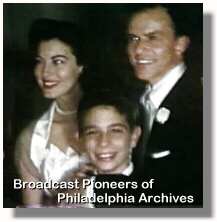
(Left to right - back row) Ava Gardner & Frank Sinatra
(front row) Broadcast Pioneers member Steve Sacks
November 7, 1951
Frank Sinatra and Ava Gardner were supposed to be married at the Levy's Philadelphia mansion on Schoolhouse Lane. However, the news leaked out and the ceremonies were moved to the home of the parents of Broadcast Pioneers member Steve Sacks. Steve was 11 years old at the time.
Dr. Leon Levy and to some extent, his brother Isaac continued to run WCAU until the beginning of August of 1949. It is believed that this was part of the contractual agreement to sell the stations in 1946. They did stay on the station's board of directors even after they had no more managerial control.
In 1947, Dr. Leon Levy commented on his running of WCAU. He recalled the early days in the twenties when he knew changes were have to be made. He said:
We were making money. They were supplying all the station's income, but we were not building anything. Most of our commercial accounts were not of the best and I was convinced that we had to have substantial advertisers selling accepted goods and service if we were to build a strong, going business.
The next year, 1948, WCAU Radio was charging $500 per hour and $300 per half-hour in the prime time period.
In the summer of 1958, the WCAU stations were sold by the Philadelphia Evening Bulletin to CBS for twenty million dollars. Some websites refer to this sale as selling the stations back to CBS. This is simply NOT TRUE. CBS never owned WCAU (prior to the 1958 sale). The Levys owned WCAU (The Paleys were minority stock holders) and a huge portion of CBS, but the two were totally separate companies. William Paley owned much of the network, but little of WCAU. There were business affiliations but ownership and management were separate.
The 1958 price included both the stations (WCAU AM, FM & TV) and the land the building sat on (a prime piece of real estate). Since that time, the back lot where "Action in the Afternoon" originated from has been sold off for office space. Two years later, the Bulletin applied for and received a CP (Construction Permit) for a new radio station WPBS (We're Philadelphia's Bulletin Station).
By the middle sixties, WCAU radio was big with the telephone talk format, with voices such as Bob Menefee, Broadcast Pioneers member Ed Harvey and Jack McKinney around the clock. Reportedly, they had the biggest and possibly best-informed broadcast news department in the area (WIP might have argued that point).
WCAU went all-news radio in 1975 but abandoned that format three years later. Some reports state that the decision for WCAU to compete against KYW was a personal thing between Bill Paley and the broadcast division of Westinghouse. Today, the Westinghouse and CBS O&O are owned by the same corporation.
Many industry people believed that CBS just didn't have their heart in the all news operation. Actually, WCAU still had telephone-talk but it was much more news oriented. Eventually, CBS was unwilling to spend enough money to beat KYW Newsradio. Money does talk. That's how WFIL beat WIBG.
For several years, the station went through many different management types, and each time someone new took over, they tinkered with the format. More news, less news, all news. Listeners didn't have a clue what WCAU was airing and with that went the "dial habit." There were reports that because of its large payroll, the station was not turning a profit for CBS. In 1982, WCAU aired a syndicated live national talk program called "The Larry King Show," long before his CNN days.
By 1986, the station came back to what it did best, telephone-talk. A new crop of hosts became known to the Philadelphia market led by former Mayor Frank Rizzo. There was also Dominic Quinn, Steve Fredericks and Harry Gross.
On August 15, 1990, WCAU Radio became WOGL. The station at 98.1 on FM is WOGL-FM. (Previous to this August date, the FM station was WOGL, but changed their call letters to WOGL-FM so that AM could become WOGL.) The station was WOGL, not WOGL-AM. There are no six letter calls on AM anywhere in the United States.
The format flip plans were hush-hush and few at the station were "in the know." Almost three dozen employees were let go. The format change shocked many broadcast experts. However, it was a cost-cutting move. This change also affected the history of Philadelphia. With Frank Rizzo no longer having a platform, he decided that he would give running for mayor another shot in 1991. Rizzo held that office for two terms as a Democrat during the seventies. He switched parties in the eighties and ran as a Republican but lost. (It was close). However, the 1991 campaign would have a big difference. This time, the GOP political machine didn't support him. He bucked the politicians and won the nomination. He would die as a candidate. If WCAU didn't change formats, would Rizzo had run? Many say yes, but many think no.
Then on March 18, 1994, the call changed to WGMP, "the Game." The station as WOGL had kept some of its sports programming (from the WCAU days) and so it was decided to go "full time" with the sports theme. Much of the station's schedule was filled with syndicated sports programming, designed for smaller markets. They also kept the Phillies broadcasts and college basketball. The ratings were never what they expected and the format was dumped by new owners Westinghouse Broadcasting who purchased CBS.
On August 23, 1996, the call letters became WPTS and three weeks later, it became WPHT (on September 17, 1996). Again the station tried a talk format with local programming including Don Lancer in the evenings. Don was transferred from now sister station KYW. (Lancer later returned to KYW). During August of 1998, much of the local programming was dumped in order to air syndicated talk shows. Except for the addition of Sid Mark to its lineup starting on December 29, 2000, the station has kept its 1998 flavor.
By the way, the WCAU call letters live on. When NBC took over WCAU-TV on September 10, 1995, they applied for a change in call letters. On October 6, 1995, the new call was approved and the TV station went from a six letter call (WCAU-TV) to a four letter call (WCAU).
Forrest Choate, a visitor to our website e-mails:
I grew up in the 20's in the Atlantic City area.... In 1937 at age 19, my family and I moved to California.... In late 1941 before Pearl Harbor I was drafted and assigned to the Signal Corps School at Fort Monmouth, NJ. While there I became friends with a fellow instructor and he had been at WCAU as an operator/engineer prior to being drafted.
I had been in a similar job at KDB in Santa Barbara, CA. This new friend and I went to Philly one weekend and he had a grand time showing off to me his skills as a patch-cord jockey in the control room at WCAU. ...A few weeks later we were each re-assigned and I never heard news of him again. After the war, I went back to AM radio for 5 years and then into a 32-year stint with NBC-TV in Hollywood (Burbank). Most of the time as a news camera person and Technical Director, retiring in 1982.
Just a few months ago I read a few paragraphs of reminiscences in a bulletin for Retired NBC people. These memories were from Greg Garrison, a director of many of the big live hour shows of the 50s and 60s. In these memories he gives credit to the Technical Director that pulled him through his first attempts at directing a live TV show. That TD that he praised so highly was Charlie Coleman. That is the same guy that took me from Fort Monmouth to Philly for a great weekend. Anyone remember him?
From the official archives of the Broadcast Pioneers of Philadelphia
Written and researched by Broadcast Pioneers historian Gerry Wilkinson
1937 & 1938 WCAU documents originally donated by Broadcast Pioneers member Dave Skalish
© 2010 & 2013, Broadcast Pioneers of Philadelphia
All Rights Reserved
The e-mail address of the Broadcast Pioneers of Philadelphia is pioneers@broadcastpioneers.com